
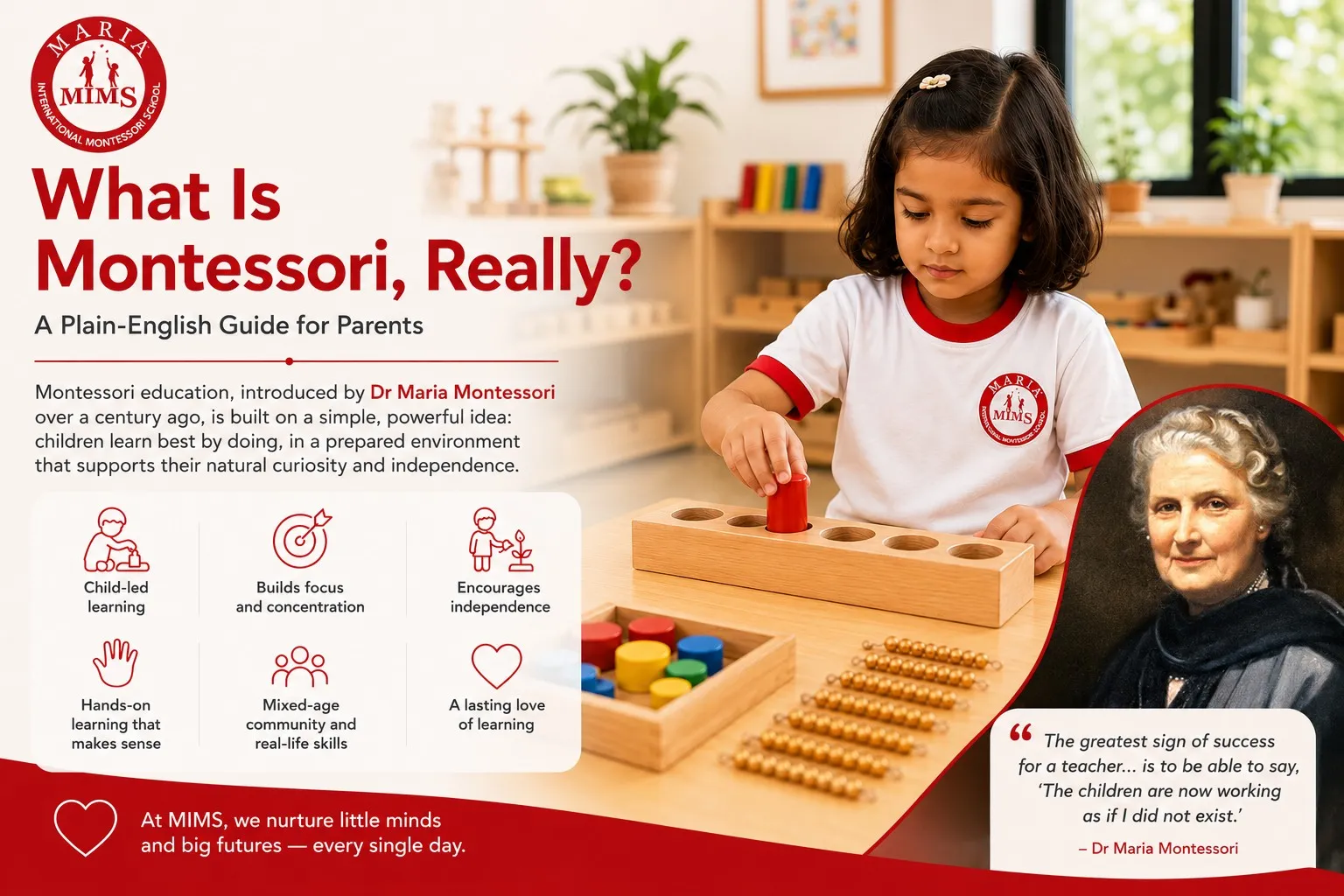
If you have started looking into early education, you have probably met the word “Montessori” more than once — usually alongside wooden trays, low shelves, and children working in remarkable quiet. It can feel like a world with its own language. But underneath the calm surface is a simple, humane idea about how children actually learn. Here is the plain-English version — no jargon, no mystique.
A method built around the child
Montessori education began over a hundred years ago with Dr Maria Montessori, an Italian physician who watched children closely and noticed something that still holds true: young children learn best not by being talked at, but by doing. Give a child a real, purposeful task and a calm space to repeat it, and they will concentrate, master it, and grow visibly in confidence.
That single observation shapes everything. Instead of a teacher at the front delivering the same lesson to rows of desks, a Montessori classroom is a carefully prepared environment full of hands-on activities. A trained guide observes each child and gently offers the next thing they are ready for — following the child, rather than marching the whole group through the same page on the same day.
Freedom within a clear structure
The most common misunderstanding is that “child-led” means a free-for-all. It doesn’t. Montessori is better described as freedom within limits. Children are free to choose their work, to move around the room, and to spend as long as they like on an activity that absorbs them. But those choices happen inside a thoughtfully ordered environment, with clear ground rules and a caring adult close by.
That balance is the point. Children practise making decisions and following through — real independence — while the structure keeps them safe, focused, and kind to one another.
Learning you can hold in your hands
Walk into a Montessori room and you will see beautiful, tactile materials: sandpaper letters to trace, bead chains for counting, small jugs for pouring, frames for buttoning and lacing. Each one isolates a single skill and lets the child feel it before they ever meet it as an abstract idea on paper.
This is why Montessori children so often move into reading, writing and mathematics with such ease. They have handled the quantity “a thousand” as a physical thing; they have traced the shape of a letter with their fingertips. The abstract concept, when it arrives, already makes sense.
The long work cycle — and the gift of focus
One of the quiet luxuries of a Montessori day is the uninterrupted work cycle: a long block of time in which children can concentrate deeply without being stopped and reshuffled every twenty minutes. In a world designed to fragment attention, protecting a child’s concentration is a genuine gift — and it is one of the method’s most lasting benefits.
Mixed ages, real community
Montessori classes deliberately mix ages across roughly a three-year span. Younger children are quietly inspired by the older ones and see where they are heading; older children deepen their own understanding by helping and, sometimes, by teaching. Along the way, everyone practises “grace and courtesy” — the small, daily habits of kindness that make a community feel warm.
So, does it work?
Yes — and not out of nostalgia. More than a century of practice, supported by modern research on how young children develop, shows that Montessori builds focus, independence, and a genuine, lasting love of learning. Those are exactly the foundations that serve a child well long after the early years are over.
Seeing it for yourself
The truest way to understand Montessori is to stand in a calm classroom and watch children at work. If you would like to see how this looks in practice, explore our Montessori Programme — or book a personal visit and come and feel the difference for yourself.